

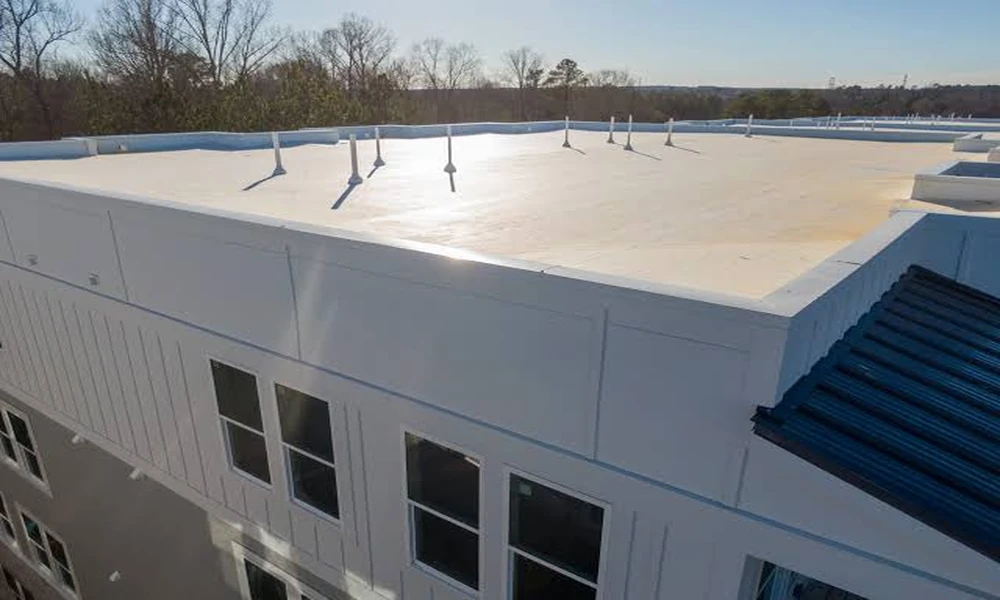
Pick the wrong membrane and you will know it by March. Snow loads compress seams, freeze-thaw cycles force water into microscopic cracks, and a material that performs beautifully in Atlanta can split wide open after one Upper Midwest winter. Commercial flat roof failures are not random. They are almost always a mismatch between climate demands and material properties, and that mismatch starts at the specification table.
If your building sits anywhere north of the 42nd parallel, the membrane decision deserves a lot more attention than cost-per-square-foot. This guide walks you through the four most common flat roof systems, explains how each one actually behaves in cold weather, and gives you a practical framework for narrowing down your choice before you talk to a contractor.
The Four Players: What You Are Actually Choosing Between
Most commercial flat roofs use one of four systems: TPO (Thermoplastic Polyolefin), EPDM (Ethylene Propylene Diene Monomer), PVC (Polyvinyl Chloride), or modified bitumen. Each starts with a different base chemistry, and that chemistry drives performance in ways that matter a lot once temperatures drop.
TPO is a single-ply thermoplastic membrane, heat-welded at the seams. The welded seam is genuinely strong when done correctly. Installers use hot-air guns to fuse overlapping sheets into a bond that is typically stronger than the membrane itself. No adhesive, no tape, no chemical that can cold-crack.
EPDM is a rubber membrane, typically adhered with contact cement or ballasted with stone. It has been around since the 1960s and has an excellent track record in cold climates because rubber stays flexible at low temperatures. The weakness is the seam system, which relies on seam tape or liquid adhesive rather than heat welding, making it more vulnerable to long-term delamination.
PVC is also heat-welded and chemically similar to TPO, though it contains plasticizers that can migrate out of the membrane over time, causing it to become brittle in sustained cold. Modern PVC formulations have addressed this significantly, but it remains a real consideration on buildings with 30-plus-year timelines.
Modified bitumen is the closest descendant of traditional built-up roofing. It is applied in multiple plies with asphalt or torch-down methods. It handles traffic well and adds up to solid puncture resistance, but it is heavier, more labor-intensive, and less reflective than the single-ply membranes above.
Cold-Climate Performance: Where Each System Wins and Loses
Temperature cycling is the single biggest stress a flat roof faces in a northern climate. A membrane expands in summer heat and contracts in winter cold, and that movement concentrates at seams, penetrations, and corners. Over years, materials that cannot flex will crack; seams that are not molecularly bonded will separate.
EPDM’s rubber composition gives it a clear flexibility advantage at sub-zero temperatures. It stays pliable when TPO and PVC stiffen slightly, which matters during installation in cold weather and during the first freeze of the season when a new membrane is still settling.
TPO’s heat-welded seam is its strongest cold-climate argument. According to the U.S. EPA’s ENERGY STAR program, cool roofs with high solar reflectance also lower roof surface temperatures and slow material degradation, extending the life of the roofing system. A white TPO membrane qualifies as a cool roof by default, which means you are getting both long-term membrane protection and a measurable reduction in summer cooling loads.
PVC performs comparably to TPO on seam strength, but specify a reinforced membrane of at least 60 mil in cold climates. Thinner membranes have more trouble with thermal shock when a sudden temperature drop follows a warm spell.
Modified bitumen is genuinely solid on puncture resistance and is a reasonable choice for roofs that see foot traffic from HVAC technicians regularly. Its Achilles heel is reflectivity. Dark bituminous surfaces absorb heat aggressively in summer, which drives up cooling costs and degrades the material faster through repeated thermal expansion cycles.
The Northern Climate Offset Principle
Here is a concept worth keeping in mind when you are comparing energy performance claims across membranes: most energy-efficiency data for reflective roofing is modeled on Southern climates. A white TPO roof saves more energy in Phoenix than in Minneapolis, full stop.
That said, the savings do not disappear in the North. The U.S. Department of Energy’s Federal Energy Management Program calculated in 2020 that an ENERGY STAR-qualified cool roof product is cost-effective if priced no more than $0.64 per square foot above a standard model, and the best available models can save up to $1.11 per square foot over the life of the roof. Even in cooler climates, buildings run air conditioning during humid Midwest summers, and a reflective membrane reduces that load every single July and August for the life of the system.
The practical takeaway: do not reject TPO or PVC on energy grounds just because you are in Minnesota or Wisconsin. The winter heating penalty from a reflective roof is real but modest. The summer cooling savings and the longer membrane life from lower peak temperatures more than compensate on most buildings over a 20-year horizon.
Cold-Climate Flat Roof Decision Matrix
| Material | Seam Type | Cold Flexibility | Reflectivity | Best For |
|---|---|---|---|---|
| TPO | Heat-welded | Good | High (white) | Most commercial buildings; energy-conscious owners |
| EPDM | Tape/adhesive | Excellent | Low (black) | Very cold regions; low-maintenance priorities |
| PVC | Heat-welded | Good (60-mil+) | High (white) | Chemical exposure environments; food processing |
| Modified Bitumen | Torch/hot-mop | Moderate | Low | High-traffic roofs; reroofing over existing systems |
Questions to Ask Before You Commit to a Membrane
A good contractor will ask most of these before proposing a system. If yours does not, bring them up yourself.
- What is the current roof deck condition, and will the new membrane be fully adhered, mechanically fastened, or ballasted?
- How much foot traffic does the roof see per year from maintenance crews?
- Are there chemical exhausts, grease vents, or HVAC condensate drains on the roof surface?
- What is the building’s insulation R-value, and is this replacement also an opportunity to upgrade it?
- What are the slope and drainage patterns, and are there any areas that pond water after a rain?
Ponding water deserves special attention in cold climates. Water that sits for more than 48 hours after a rain event is a problem on any flat roof, but in the North it becomes ice, and ice introduces shear forces along the membrane edge that adhesive-bonded systems handle worse than heat-welded ones.
Why Installation Quality Matters as Much as Material
“The membrane is only as good as the installer’s seam work. A perfect material installed carelessly will fail faster than a decent material installed with precision.”
That reflects the consensus view across flat roofing professionals. The heat-welding process for TPO and PVC requires calibrated equipment and trained hands. A seam welded at the wrong temperature or speed leaves a weak bond that will not be obvious until the next polar vortex. Certifications from membrane manufacturers are one reasonable proxy for installer quality, though a contractor’s specific regional experience, particularly with northern winters, carries just as much weight.
Contractors who specialize specifically in flat and low-slope systems typically carry deeper membrane-specific knowledge than general roofers who do everything from shingles to gutters. For instance, providers offering TPO flat roofing systems in the Twin Cities focus exclusively on the membrane types and installation details that define long-term performance in a climate where February temperatures can swing 40 degrees in a single week.
Timing the Replacement Right
Cold-climate flat roofing has a real installation season. Most membrane manufacturers specify minimum application temperatures, and heat-welded membranes in particular need ambient temps that allow the weld to cure properly without contracting immediately. Late summer through early fall is the window most experienced contractors prefer in the Upper Midwest. Spring installations are possible but riskier, since late cold snaps can disrupt curing.
If your roof is already leaking in January, your options narrow fast. Temporary repairs buy time, but they are not a substitute for addressing the underlying membrane failure. A qualified contractor can assess whether a targeted repair will hold through the rest of the winter or whether the membrane integrity is too far gone to patch effectively.
Whatever material you land on, the North does not forgive deferred maintenance. A roof that gets inspected and minor issues addressed annually outlasts one that gets looked at only when water shows up on the ceiling. Schedule that inspection before the freeze-thaw season starts, not after it.
